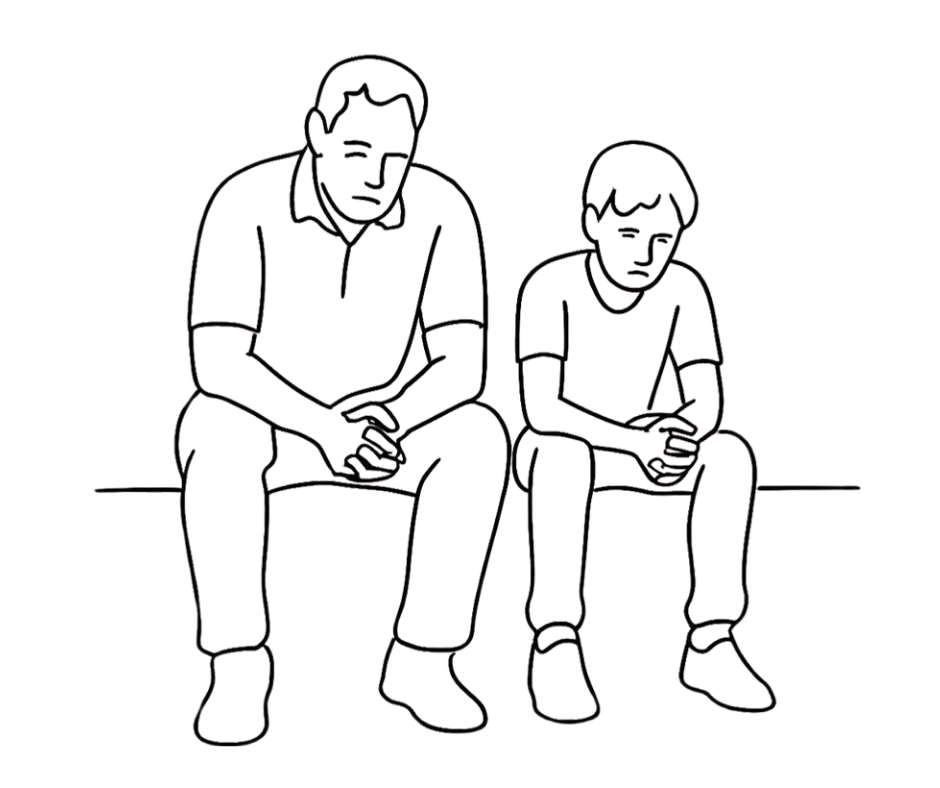
There's a moment many fathers rarely talk about: you try to start a conversation and he barely looks up. You try again. Same result. You tell yourself it's just the age, or just the way he is. But something in you knows it's more than that. The disconnection isn't a failure. It's a gap in foundational knowledge that nobody ever gave you.
He's sitting at the kitchen table when you come home. Headphones on. Phone in hand. You say his name. He glances up, nods, goes back to the screen.
You get a drink, stand there for a moment. Try again. Ask about his day. He says "fine." You ask what he did. "Not much." You nod. You run out of runway and leave the room.
Later, you think about it. You wonder if you should try harder. If you should have pushed through the one-word answers. If the problem is you or him or something in between. And then the thought arrives that you've been avoiding: maybe this is just what it's going to be now.
A lot of fathers go through this. Most of them don't say it out loud.
What's really happening
The disconnection you're feeling isn't evidence of a broken relationship. It's evidence of a gap, and the gap is this: nobody ever taught you how to connect with a person who processes the world the way your son does.
You were taught, mostly by example, to provide. To protect. To solve problems. To show up. Those things matter. But connection runs on a different channel, and the channel most men were trained on is largely about words, about direct conversation, about navigating emotion through talking it through.
Some people, a lot of teenage boys among them, don't connect that way.
They connect alongside. They connect in shared activity. They connect through rhythm and repetition, through the same thing happening in the same way over time, through showing up consistently without demanding anything.
It's not that he doesn't want connection. It's that the shape you're offering doesn't fit the shape he can receive.
This isn't his problem to fix. It's information.

The knowledge nobody gave you
I've worked with hundreds of families, and there's a pattern that shows up with fathers more than anywhere else. Men who are competent in every other area of their lives, who are good at reading situations and making decisions and getting results, who are at a complete loss when it comes to their own child.
And the reason isn't that they're failing as fathers. The reason is that what they're missing is foundational knowledge about how development works, specifically about how connection, communication, and rhythm work in young people.
Schools didn't teach this. Their own fathers didn't model it, because their fathers didn't know either. And the parenting books that feel like they're written for someone else, they usually are. They're often written for mothers, about mothers' experiences, in a communication style that most men find hard to enter.
So these fathers are trying to connect without a map.
And then they find that the harder they try, the more their son retreats. And then they stop trying as hard. And then the gap widens.
It's not anyone's fault. But understanding what's underneath it changes what's possible.

One thing that works
The basketball hoop story I tell in workshops, which I've already written about elsewhere, is the simplest illustration I know.
But the principle behind it applies well beyond basketball. It's this: shared activity before shared conversation, every time.
Find something you can do alongside each other. Doesn't have to be interesting to both of you. Doesn't have to be athletic. Driving somewhere. Building something small. Cooking a meal. Walking the dog. Whatever it is, it needs to be low-demand, side-by-side, and consistent.
No questions about feelings. No agenda. Just the activity.
And then wait. Not for a week. Over weeks and months, wait. Some things emerge in that space that would never emerge in a face-to-face conversation. Observations. Small disclosures. The beginning of something.
That's the simple next step. Not a breakthrough. A starting point.
The more you understand about how development works, about why your son processes the world the way he does, and what he needs underneath the silence, the more that starting point opens up.
Has a son between 14 and 18?
The Young Founders Program is built around exactly these principles. Not another thing he has to do, something that meets him where he is.
Join the waitlist →