The Framework
Seven foundations. Built in sequence. For life.
Most approaches to learning work on skills: reading, writing, attention, behaviour. The 7 Seeds works on the layer underneath those skills: the foundational capacities from which everything else grows.
When foundations are incomplete, children compensate. Compensating works, but it burns extra energy every day, and it runs out. That's why some children do fine until grade 3, then slide. The ones with less to carry make it to year 7. Then they slide. They haven't stopped being smart. They've maxed out their compensating capacity.
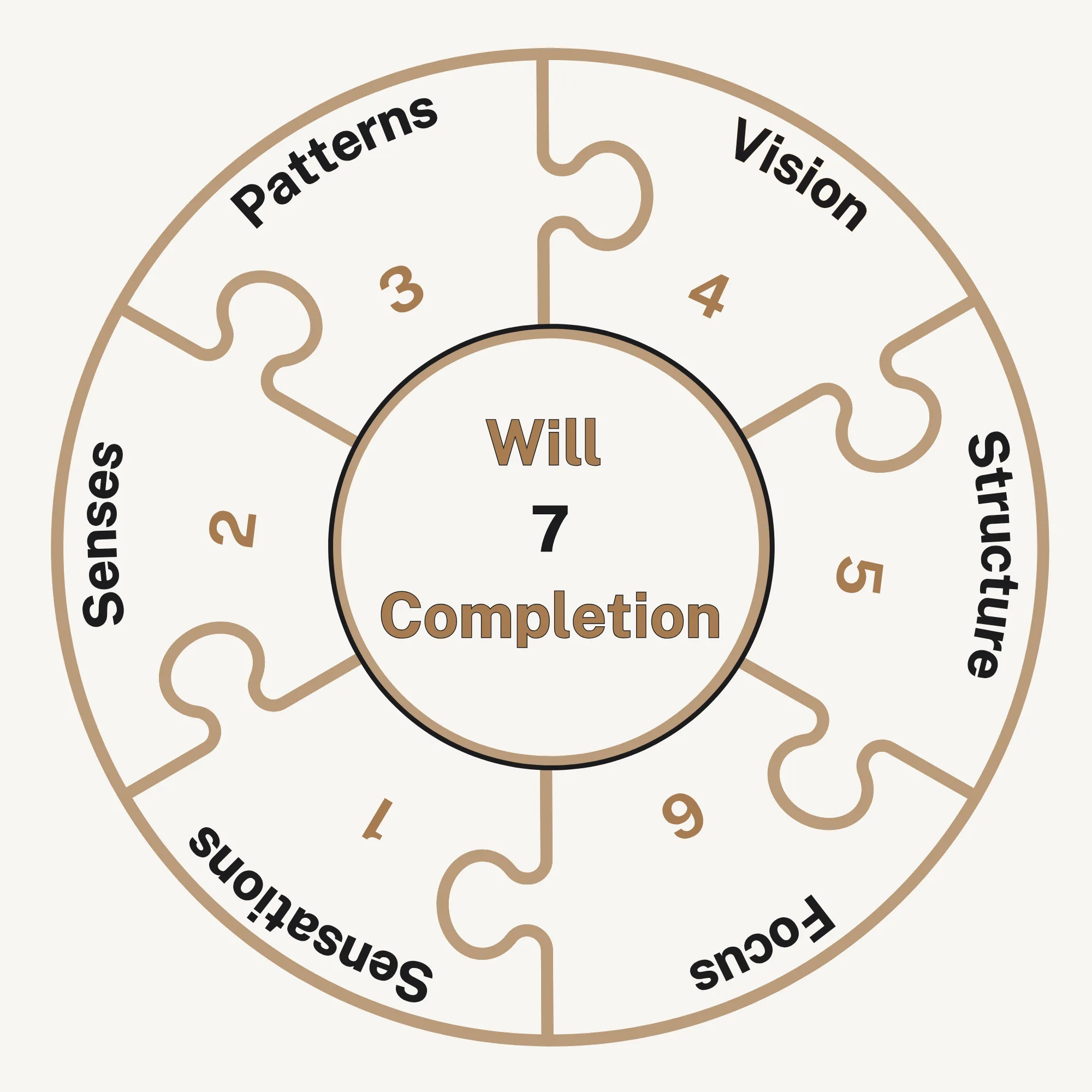
Seven capacities, built in sequence. When they develop in order, everything else follows on its own. When a step gets skipped, the child finds a way around, and the workaround has a cost.
Internal body awareness. Knowing where you are in space. The felt sense of your own body.
In daily life: A child who crashes into things, who doesn't know how hard they're pressing a pencil, who doesn't notice they're hungry or cold.
When developed: Coordination improves without practice. Emotional regulation becomes possible. The child knows themselves.
Processing and responding to the external world through the senses.
In daily life: A child who is overwhelmed in noisy spaces, or who can't filter background noise during conversation.
When developed: The child can be in the world without being consumed by it.
Recognising and working with cycles, sequences, and natural order.
In daily life: Reading, writing, and maths all depend on pattern recognition. A child who struggles with these, often before there's any "learning difficulty" diagnosis, may simply not have this foundation in place.
When developed: Memory, language, planning, and sequencing flow naturally.
Visualisation, imagination, and the ability to hold a mental image.
In daily life: The child who can't picture a story being read to them. The adult who can't hold a plan in their mind long enough to act on it.
When developed: Creativity, goal-setting, and the ability to learn from description rather than demonstration.
Creating frameworks that channel energy toward results.
In daily life: My son, about seven, decided to build a house out of sticks on our gravel driveway. Nothing to anchor into. The taller it grew, the more it leaned, and when it collapsed he didn't blame the gravel. He decided he wasn't a builder, and stopped trying. That is what a missing structure foundation looks like: the child concludes something about themselves.
When developed: Projects get finished. The same boy, fourteen years on, stripped and rebuilt an entire apartment on his own, from the design to the herringbone floors, and never once decided he couldn't.
Directing attention consciously, both laser-sharp and broad.
In daily life: The child labelled with attention difficulties who can, in fact, focus for hours on things they've chosen.
When developed: The child can choose where to put their attention, and sustain it.
Following through from intention to completion. The willingness to try, fail, and try again.
In daily life: The child who gives up the moment something gets hard. Or the one who never starts, because failure feels like proof of something.
When developed: Resilience, self-direction, and the capacity to make and own decisions.
I tested this for over twenty years in my practice. Every child who came to me carrying a learning difficulty label, without exception, could not clap to an even metronome beat. We never drilled reading or maths. We built rhythm, and academics moved on their own. And the adults who came to improve their eyesight got unexpected side-effects: anxiety reduced, finances untangled, repeating relationship patterns stopped repeating. They thought they came for their eyes, not realising vision processing was linked to everything else.
These foundations apply throughout life, not just in childhood. The same seven capacities underpin everything an adult does: in work, in relationships, in learning anything new.